… on rough days, and gratitude, and how this thing came about
There is always one good thing in a day.
I often remind myself of this. Because it feels true. And because I need to. When my body just aches and I haven’t the strength to shower and the apartment feels empty and silent, except for the whirring of a fan and a space heater. Days like that, I need the reminder. Days like today, in fact.
Restless, craving some company, I get looking about for Ellie — my constant companion, my feisty stray sweetheart of a cat — but she must be sleeping on her pretty patchwork quilt in the bedroom window.
“That’s your Great Grammie’s quilt,” I often tell her. “Did you know that? Your Grammie’s Mom. She was a lovely soul.”
When you live alone, you talk to your cat — often. Well, I do, I should say. It’s not a universal truth, of course.
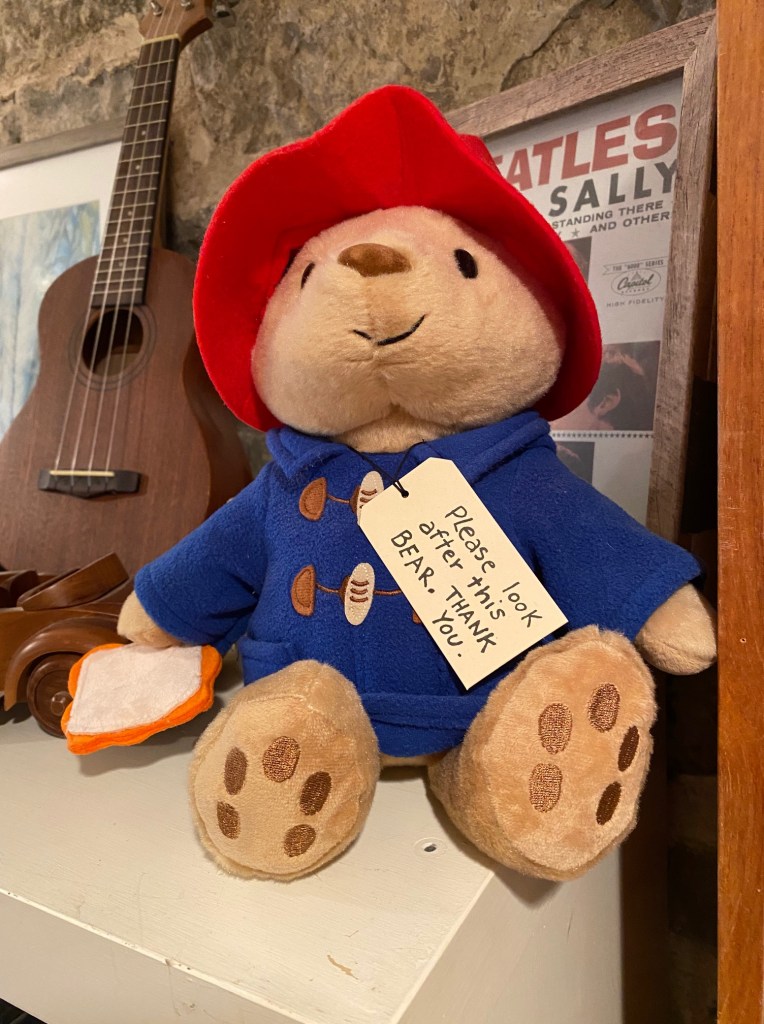
Couple of years ago, I bought a Paddington bear, a stuffed animal, a children’s toy, I suppose. But I like him and he sits atop a bookshelf in the kitchen space with his floppy red hat and handsome blue raincoat, holding in one hand a rather squished-looking marmalade sandwich.
Here he is.
On rainy days, if I happen to be in the kitchen, and I’m in the right mood, I’ll tell him, “It’s chucking down out there, Paddington. You’d like this day, I think.”
And yes, I begin to wonder if I’ve gone mad. Or if other people do this: talk to their cats and stuffed animals. Then I think of my age and feel a sort of inward shiver, and then comes a thought like, “How did I get here?”
We all have difficult moments, though: rough days, bouts of poor health, periods of loneliness; a day, a week, a month, maybe even a year when nothing, or at least very little, seems to be going right.
The good thing about hitting rock bottom, someone might say (and they do, they say this), is that things can’t get any worse, they can only get better. There might be a grain of truth to that. Then again, I’ve always thought people who speak in clichés should live on an island with others who do the same. Think of it: No one would watch a reality TV show called “Cliché Island.”
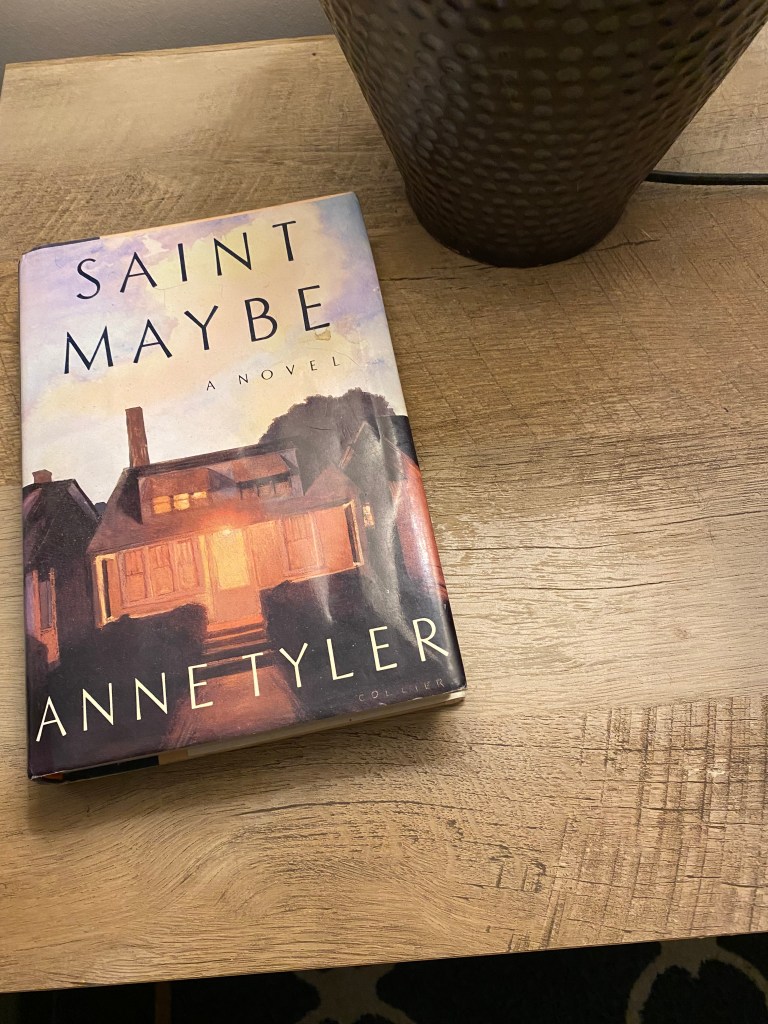
Anyway, a point: Earlier I was sitting on my one front step, reading Anne Tyler’s resplendent novel Saint Maybe. When I’m having a bad day (awful pain, restlessness, little energy, foul mood; you get the idea) — I often pick up one of Anne Tyler’s books for comfort, and normally it comes almost immediately. Thankfully, it did again today.
The copy of Saint Maybe I keep on my nightstand, always.
I was reading a scene about a family celebrating Christmas. Ho-hum stuff normally, but not in Tyler’s hands. I mean, out of nowhere came this sentence: “The cat threw up an oyster behind the couch.”
And I hiccuped a laugh.
Then I realized I was smiling for likely the first time today. And right there — that was the one good thing, I found myself thinking. That graceful, deceptively simple, comical sentence. And that it made me smile and laugh.
And that’s how this little blog or web site got its name, really. Because I feel like, these days, we all need to read about things that are good, things that are kind and gentle. (I’m quite fond of kind and gentle, you could say.)
How to highlight that need?
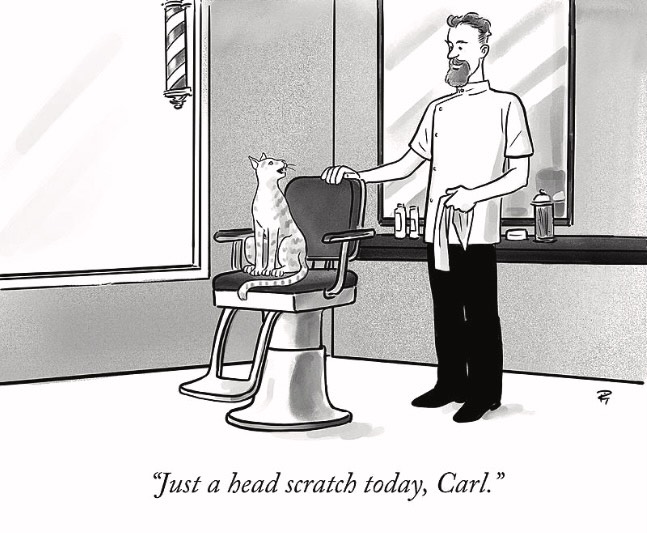
Okay, I’ll try this — I imagine getting my haircut at a barbershop and asking the barber, seemingly out of the blue, “How do you stay sane?”
“Hmmm? Sane?”
“Yes. I mean, with all the sadness in the world. And people right here in Kingston sleeping in tents. I mean, what keeps you going?”
The barber in this vision is kind and gentle. He’s also a sort of practical thinker. And a kind-hearted bloke. “Well, I cut people’s hair,” he says. “One person at a time. I give them the best haircut I can. And ask them about their family, their job. It’s interesting, sometimes fascinating, really. People are, that is. Anyway. I just give good haircuts and talk to people ‘til it’s time to go home, I guess. It’s not so bad. It’s quite pleasant at times, actually.”
“Just a Head Scratch” by Pia Guerra. The New Yorker, January 2019.
And I think maybe that’s why I’m writing this today: to remind myself that it’s okay to be vulnerable. To feel like shit and to tell someone about it. I think the opposite would be kind of silly, ya know? Keeping it all inside. That mostly feels awful.
And I’ve come to believe that one of the most wondrous things about other human beings, even total strangers sometimes, is this: how very kind they can be, how understanding, and how grateful they are to help in some way, with a thoughtful word or two, an affectionate clap on the shoulder, or merely a considerate look and a nod that says, “I know. I hear you.”
Ya know?
And to me that’s a really lovely thing. Not a sappy thing. But a blessing, a gift. And it happens all the time. I’m mindful of that now.
That’s my cue, I think — my mindfulness cue, if you will — to get up and stretch and breathe in some cool fresh October air. To be thankful for that, too. And later, to tend to my body and mind, to rest awhile and do a guided meditation.
I just checked on Ellie, by the way — and she’s not sleeping on her Great Grammie’s quilt in the bedroom window, but looking quite blissed out on the mussed-up bed covers, her head near the pillows. (I bet she uses them like a person when I’m not home.) I gave her a kiss and told her I loved her. But she didn’t wake up.
Another “one good thing.”
Well, many of them, really.
I’m honestly beginning to think that maybe that’s the point.
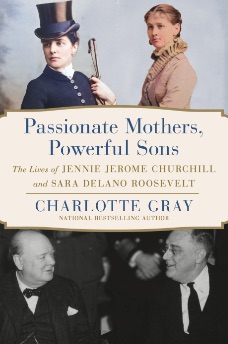
In conversation withaward-winning biographer and historian, Charlotte Gray, about her luminous new double biography, Passionate Mothers, Powerful Suns: The Lives of Jennie Jerome Churchill and Sara Delano Roosevelt
During a pandemic lockdown, Charlotte Gray’s long-time editor, Phyllis Bruce, told Gray about a remarkably interesting fact: that Jennie Jerome and Sara Delano were born in 1854 within 100 kilometers of each other in New York State. Gray, one of Canada’s finest historians, was reasonably intrigued. So intrigued, in fact, that she decided to write a dual biography of the mothers of Winston Churchill and Franklin Roosevelt, Passionate Mothers, Powerful Sons: The Lives of Jennie Jerome Churchill and Sara Delano Roosevelt.
“I’ve always enjoyed writing about women, and not just the pioneers, like Susanna Moodie, or path-breakers, like Nellie McClung,” Gray explained. “My very first book was Mrs. King, about the mother of William Lyon Mackenzie King. Phyllis had been thinking about my next project, and said, ‘Why don’t you come full circle?’”
Gray decided to.
“I was intrigued by the coincidence of their births,” she said, “and then — as I read more widely — by the difference in their trajectories. But there were similarities too. Both shocked their parents with their choice of husbands. Both were widowed early. Each was, in her own way, a formidable woman, with many strong views and interests. So I wanted to see how, within the restrictions on women’s roles during their lifetimes, both were able to exert a lot of agency.”
When she began her research, Gray was challenged by the fact that the biographers of Churchill and FDR — who were almost all male — tended to denigrate both men’s mothers, and minimize their roles in their son’s lives.
“They reflected the misogyny of the late nineteenth and twentieth century, and always emphasized Jennie’s party-going and debts, and Sara’s over-protective maternal style. I wanted to right the balance,” Gray said. “My approach was to see what the women, and their contemporaries, had written about them, before both became overshadowed by their sons.”
Initially, Gray had trouble accessing key primary sources.
“Covid lockdowns were not good for biographers; we couldn’t access the raw materials in archives,” she explained. “I was thankful that I had chosen subjects from famous families, so there were quite a lot of secondary sources — published memoirs, volumes of collected correspondence — from which I could draw.”
When lockdowns ended, Gray was hugely relieved and travelled to Churchill College in Cambridge for “the Jennie material,” and the Franklin D. Roosevelt Presidential Library in the Hudson Valley for “the Sara sources.”
“I could touch the paper on which they had written to their sons,” she said. “I could check that I hadn’t missed anything, or if previously-published letters had been edited too rigorously. I could see the wild swirl of Jennie’s handwriting, and the careful precision of Sara’s cursive. I could go through their photo albums, and collections of dinner menus. I would love to have spent far longer in both places.”
Still, she came away with reams of excellent material. In the hands of one of Canada’s finest biographers, the book crackles with these fresh, fascinating, insightful, and generous details.
Gray’s hopes for readers of Passionate Mothers, Powerful Sons are multifold.
“I want readers of this book to enjoy seeing how two strong-willed women could shape their own lives, even within the restrictive gender assumptions of the nineteenth century,” she said. “I expect that readers will also enjoy the social history and political context in which I embed the biographical details. I hope that a deep dive into these women’s stories will allow readers to learn what has and hasn’t changed in the pattern of women’s lives.”
“Exploring their complicated relationships with their sons proves that there is no cookie-cutter ideal way of raising a child,” Gray added. “However, in both families, the mother-son bond was super-strong, and both men emerged from their childhoods with rock-solid egos — an essential ingredient in political success.”
The book, an instant bestseller in Canada, has been widely praised as “entirely original and brilliant,” “magnetically written,” deeply perceptive and superbly researched. I wholeheartedly agree with those assessments; Passionate Mothers, Powerful Sons is a luminously insightful examination of the lives and influence of two truly remarkable women. It reads like a fine novel (hums along at a good speed; its “characters” are thoroughly compelling) but as a dual biography that deftly weaves together the parallel and complicated lives of Jennie Jerome Churchill and Sara Delano Roosevelt, it is a masterpiece.
Gray’s latest belies the belief, still held in some circles, that historical non-fiction is boring. A skilled and shrewd historian, Gray is mindful of this.
“Historical non-fiction can be criminally boring, when it is just one damn thing after another,” she admitted. “If people want ‘just the facts,’ they can go to Wikipedia (although many facts are challenged these days.) But great historical non-fiction should be a narrative that tells a story with insight and accuracy, while illuminating a larger context for the reader. I’m always asking myself, ‘What does the past look/smell/sound/taste like? What was it like to stand on Fifth Avenue, in Manhattan, on an October Sunday in 1854?’ I want to take readers into the past. I learned my writing skills by writing for magazines, in Canada and Britain. The editors taught me how to structure a story and bring it alive. The death of so many good magazines in Canada has meant that younger writers may not get that chance today.”
Gray confessed that writing Passionate Mothers, Powerful Sons was “very hard work,” especially because she was essentially writing two biographies.
“There were times during writing the first draft when I felt crushed by the challenge I had set myself,” she said. “The Covid lockdowns didn’t help – in normal times I recharge my batteries by seeing friends, playing tennis, visiting libraries and archives, and meeting people. My husband was terrific at keeping my spirits up, and cooking delicious meals for us.”
Still, writing the first draft wore her down.
“However, once I had completed the first draft, and the world began to open up,” she was quick to add. “I started enjoying the reshaping, rephrasing and ruthless cutting that is part of the second draft. And I was starting to get positive feedback from my editors, so my confidence grew. Now, the fantastic reception that has greeted Passionate Mothers, Powerful Sons fills me with joy.”
Passionate Mothers, Powerful Sons: The Lives of Jennie Jerome Churchill and Sara Delano Roosevelt is available to buy at your local independent bookstore, and everywhere fine books are sold.
This interview was originally published in the October 2023 issue of The Humm. For graciously allowing me to share it here, thanks to my publisher Kris Riendeau.
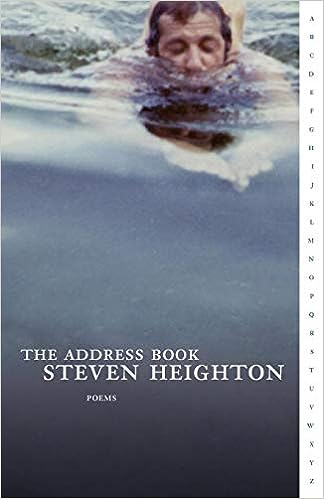
That’s a line from Steven Heighton’s poem “Gravesong.” You don’t really need any context to find deep meaning in those words. I don’t. Because lines from that poem just sing to me, like this one does, like lyrics do, and that’s likely how they came to Steve, too — from his “night mind,” a song sung to him in his sleep possibly, one he madly scribbled on paper when he woke.
He would do that. I love that he did.
At any rate, it’s a good line to have written on a scrap of paper and tacked to a cork board by your desk, if you have one. It’s a perfect reminder to a writer — to write. To snap out of it, if you happen to be in a funk. To focus or refocus. To get it down.
“Gravesong” is from Steven Heighton’s The Address Book. The arresting photo on the cover of the book was taken by Nancy Friedland. Long before I knew who Nancy was, I loved the art work. Initially, I’d thought it was a painting, it just has that grainy yet somehow smooth look to it, nuanced details that seemed to me intricately, beautifully captured by an artist’s brush with oil paint on canvas, and not a camera. But no, it’s a a photograph, and a gorgeous one. Looks to me like a snap from the ’70s — a middle-aged man swimming in a lake, reaching out mid-stroke, eyes closed, perhaps a little girl on his back for the ride. But that part is cropped out, so there’s an inkling of something more.
That is one of the beautiful things that draws me to certain works of art: the details of what they show, and the mysteries of what they do not. Albert Einstein famously wrote, “The most beautiful thing we can experience is the mysterious.” And I agree wholeheartedly.
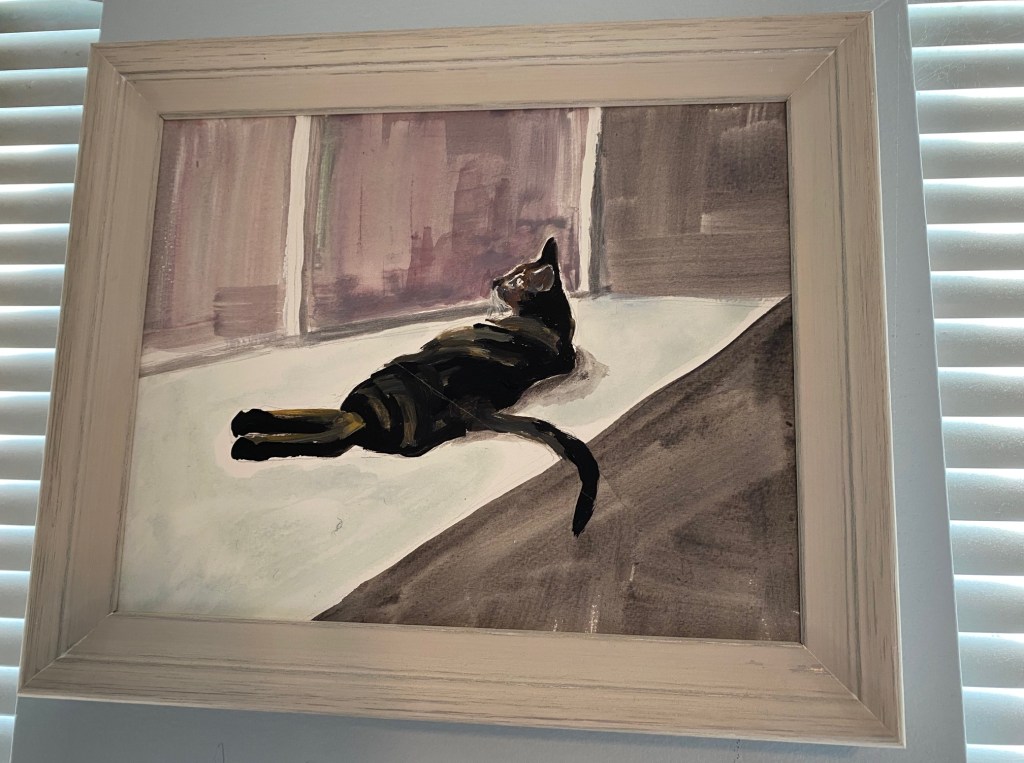
Yesterday, Nancy Friedland sent me a gift. I’ve known Nancy for a few years now, through mutual friends and social media, and I’ve come to deeply appreciate her art — and her kindness. A few years back, out of the clear blue, I got a big package in the mail: it was the most exquisite painting of Ellie, my cat and near-constant companion. I’d been having a rough time with depression and grief, and maybe physical pain as well, and Nancy painted Ellie out of the kindness of her heart, got my address from a mutual friend, I suspect, and mailed me this incredible gift. I marvelled at that painting for quite a long time — in joy and wonder, happy, grateful tears spilling down my cheeks. Then I saved up some money and had it professionally framed. I cherish it, still. It’s soothing, brings me joy, and reminds of the kindness of others.
Ellie by Nancy Friedland.
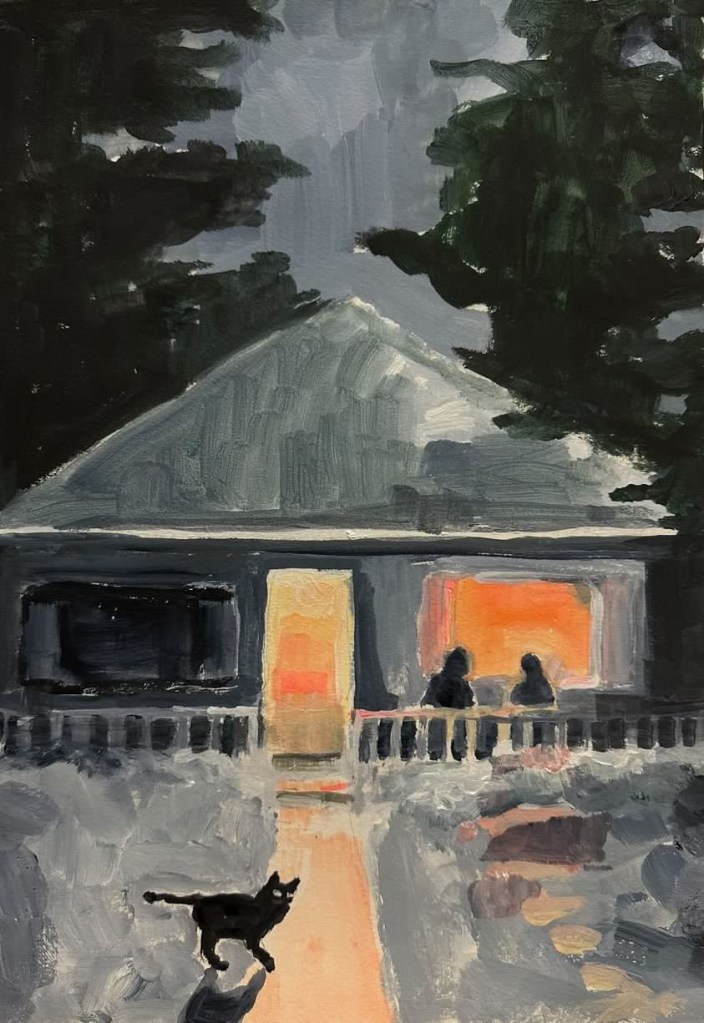
That’s backstory to yesterday’s gift from Nancy: a new painting.
This one has no name that I know of, but it’s something I asked Nancy about — if she’d ever painted something specifically for a writer who was working on a novel; an image, say, that would serve as “temporary” cover art for the book. I’m unsure if she had done that before, but she very kindly agreed to do it for me. And I’m absolutely thrilled at the remarkable painting she sent me yesterday, which I suppose I’ll call The Winter Roommate, the title of the novel I’m working on.
The Winter Roommate by Nancy Friedland.
I see so much in this painting. (I see worlds and stories!) The cozy warmth of the light glowing in the windows. A welcoming home, a cottage-like home in the city. Two people talking on a patio in winter, and it’s clearly an intense and intimate conversation, in the private universe of that warm glow. Their backs are facing the street, which seems to me an intriguing invite — so that passersby would surely think, “I wonder what those two are taking about?”
Those two people, whom I know very well now, might be facing each other, too — even I don’t know. But that’s the magic of this masterful art: it’s alive, it’s moving. So that, yes, at once they appear to be facing one another, and then, on second glance, the woman on the right seems to be looking inside the cottage, likely deep in thought, and the man might be too.
“Oh, no,” I can hear someone saying, “She’s definitely looking at him. She’s calmly studying him and listening with affection.”
Everyone will see something different, of course.
That’s the magic.
Good art really is instant, intense inspiration, too.
That cat is a mischievous stray who likes to tightrope-walk the porch railing. He roams but never far. And I love that he appears to be playing with his shadow. Perhaps, too, he’s aware of the conversation but also of something across the street — a squirrel scurrying up a hydro poll, a neighbour out shovelling snow. Or just maybe he’s looking at us. Cats are magical too, really. Who hasn’t wondered what a cat is thinking? Who hasn’t tried to figure out why cats do what they do? There’s beauty in that mystery too.
Those majestic pine trees have their own stories, shading that space long before the charming little cottage-like home was built. The cottage is set back from the quiet street, too, which lends it an even cozier feeling, I think, and you can just imagine a lovely space out back as well — perhaps a garden in a small backyard, and maybe it’s backed by a stream, and all of it sheltered by those beautiful pines. Three seasons of the year, the backyard is a quiet, soothing haven, a place to rest and read; in spring, its garden is gloriously in bloom.
The lighted walkway is an invitation too, lit by the warm glow of the front door. Which is open, it almost appears, or, at the very least, it’s not locked. Most certainly, this is a welcoming home.
It’s a sort of finish line for me, but more so a better, clearer vision of the space my characters inhabit — in present time, at the moment; and perhaps in present time when the book is complete.
That photo on the cover of The Address Book is on Nancy’s website (nancyjanefriedland.com), as are many of her luminous paintings, and yes, as it happens, there is a young girl on that swimmer’s back. I can’t recommend or praise Nancy’s art work highly enough. Truly, it speaks for itself. Check it out.
Three of her paintings were featured in the August issue of Harper’s, accompanying “The Return,” a wickedly good and haunting short story by Joyce Carol Oates. If you can get yourself a copy of that, you’ll know just how affecting Nancy’s artwork is in the midst of a story. They are not merely complimentary scenery. They add depth to the story, yes. But they are worlds within another world. Stories in a story.
Nancy’s gift came on a hard day. But it touched me deeply, and today I feel immensely inspired and excited because of her magnificent painting.
“It’s wake yourself now or never be woken.” I like to think Steve did write that line as a lyric, the poem as a song. (The word song is, in fact, in the title; there’s a clue, huh.) And that he meant it not as a one-time thing. Lyrics stick in our heads. Some become mantras. Others inspire. Some are just fun. Some we quote. Steve was smart enough to know we all, from time to time, fall into little slumbers in life, and that sometimes we need that gentle and precious reminder to wake up.
Nancy’s gorgeous gift woke me up, just when I needed it most.
After a ridiculously challenging “pain day” yesterday, I felt marginally better this morning, so I went shopping with my parents. That’s not even the weird thing.
We went to the pharmacy and then to a way-too-expensive grocery store. (The kind I think of as a “gourmet” grocery store — for people with a large amount of disposable income, I would think.) I managed to fit my four items on Irving, my walker, and this was quite a task in itself, since, as I had two packages of freshly-made blueberry muffins and two six-packs of Coke Zero, the tall, rather heavy, somewhat bulky bottles. They were on sale. That was why I wanted to shop there.
I am incapable of not buying a remainder-binned book by Anne Tyler, even when I own many editions of the very same book. It’s a charming addiction, some might say. Although not my frugal father.
At any rate, I had a friendly chat with the kind lady helping people at the self-checkouts. Though I was very tired after a rough, toss-and-turn sort of sleep, I was feeling chatty. I scanned the blueberry muffins, which prompted the kind lady to say, “Oh, I don’t know what they were making back in the bakery this morning, but it smelled absolutely delicious.”
I smiled. I said, “Isn’t that wonderful.” And I meant it too. I went on, as I’m prone to do when half-asleep: “I used to own a bookshop and there was a bakery just down the street. Every morning when I’d open the shop, I could smell that freshly baked bread — and, yeah, it was so lovely.”
“It is,” she agreed. “And tempting.”
“Yes! Very.”
I told her about a friend in Westport who owned his own bakery, and woke at 3 or 4 a.m. to do most of the day’s baking. He’d turned his sprawling garage — maybe it was once a carriage house? — into a first-class baking operation. Church Street Bakery was the name of the place, and it was outrageously popular, the food positively scrumptious, especially my favourite — the cinnamon rolls. They were often sold out of goodies by 11 a.m. Because of people like me.
So, after a pleasant chat with this really nice lady, after I’d scanned and bagged my items, I set off. I might have even said, “Have a nice day.”
Bit of a blur, that moment. Eventually, the lady (and I rather wish I knew her name, at this point; I’m normally good that way, but, alas, not today) said something about not forgetting to pay, or similar.
I barked a laugh. “Oh my!” My ears burned red, and I wheeled Irving around. “I actually completely forgot!” I laughed again, reaching for my wallet. “I can’t believe that. Sorry. I got yammering on. I do that.”
She touched a button on the screen, and winked at me. “They do like you to pay,” she said.
And that made me laugh, too. I couldn’t stop laughing, actually, while I was actually, finally paying — and after, when I was rolling out of the store. I was still laughing when, back at the van, I told my dad what happened. Dad laughed, too.
Next stop: Giant Tiger. There, I snagged a bag of Rold Good Pretzels, the crown jewel of snack foods, in my opinion, and something I like to snack on while writing. Then I made my way, as I always do at the Giant Tiger Boutique, as a writer friend of mine once called it (and maybe the store actually advertises it as such; at some point, every business, it seems, feels the need to “hip it up”) to the book section, which is essentially a small remainder bin of dusty titles with warped covers.
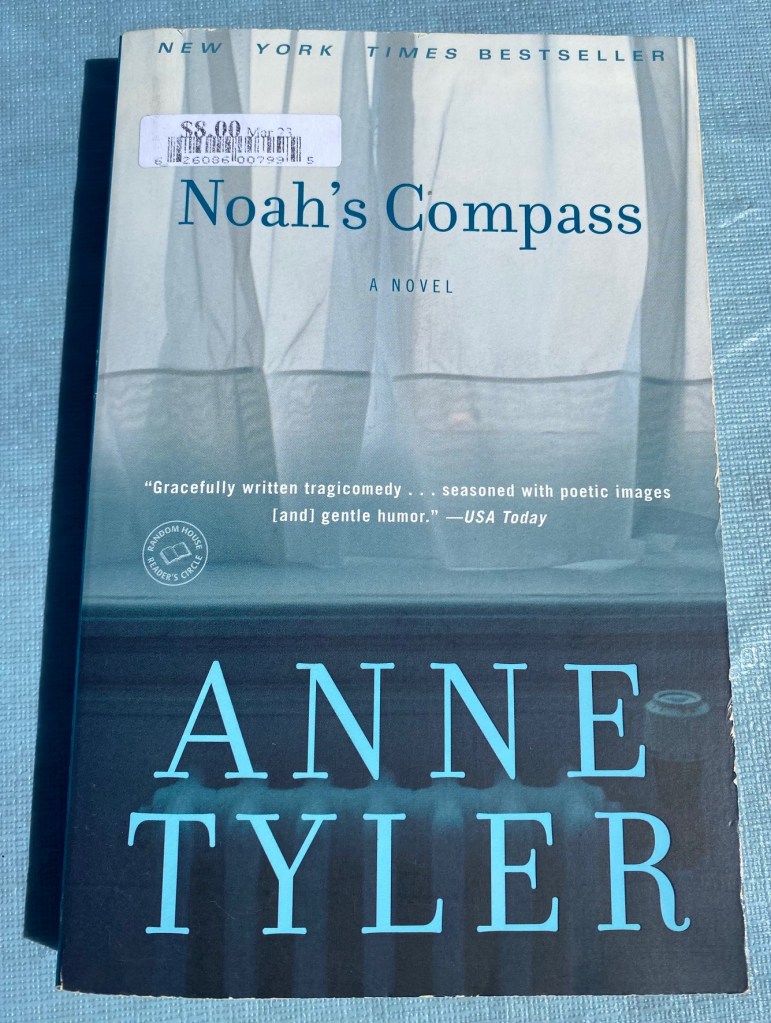
I spotted a copy of Noah’s Compass by Anne Tyler, and plucked it out. Eight bucks. I read the first sentence: “In the sixty-first year of his life, Liam Pennywell lost his job.” I smiled. I remembered Liam well. I remembered it’s a bit of a sad story, Liam’s, but one I’d thoroughly enjoyed — enough to remember Liam quite fondly.
Thing is, I own several copies of this book. They’re on a bookshelf at my home. I’d wager I own at least five copies of it. The first edition hardcover, and the trade paperback — this very version (published by Ballantine Books), or several of them, and an edition or two that was subsequently released. It would be a waste of $8 if I bought the book, really. That did occur to me. I mean, why not pick out something else?
Because I was feeling sad and pained and, frankly, at this point, near tears. (Pain accumulates and, I have found, tears are inevitable; it’s simply a matter of time — the sadness needs to be let out.) Seeing Anne Tyler’s name on the cover of the book — and it’s a simple cover, but quite lovely, decked out in appropriately soothing colours — was like seeing an old friend, and I felt comforted. And I couldn’t very well leave a good old friend behind, so in my head, I told myself: Fuck it. You didn’t bring any Anne Tyler with you. This will bring you joy and comfort, and inspire you to write.
I set the book on Irving’s seat, next to the pretzels. This time at the self-checkout, I remembered to pay. And to hell with the total, I felt so happy to be taking Anne Tyler home with me, I didn’t even look. I was already looking forward to reading about Liam Pennywell again.
Is a bit of peace of mind worth $8 to you? It is to me.
And, who knows, maybe I’ll one day gift this copy to a friend.
Back at my folks’ place — where I’ve retreated to write and get a respite from the concrete and noise of the downtown, where my home is — I sat down at the dining table (my “writing table”) on their back deck and opened the book. One of the first things I read was a blurb by The Independent (UK) on one of the inside pages. “Like her contemporaries Alice Munro and Carol Shields,” it said. “Tyler has always been drawn to life’s unheroic survivors … Comforting and cadenced.”
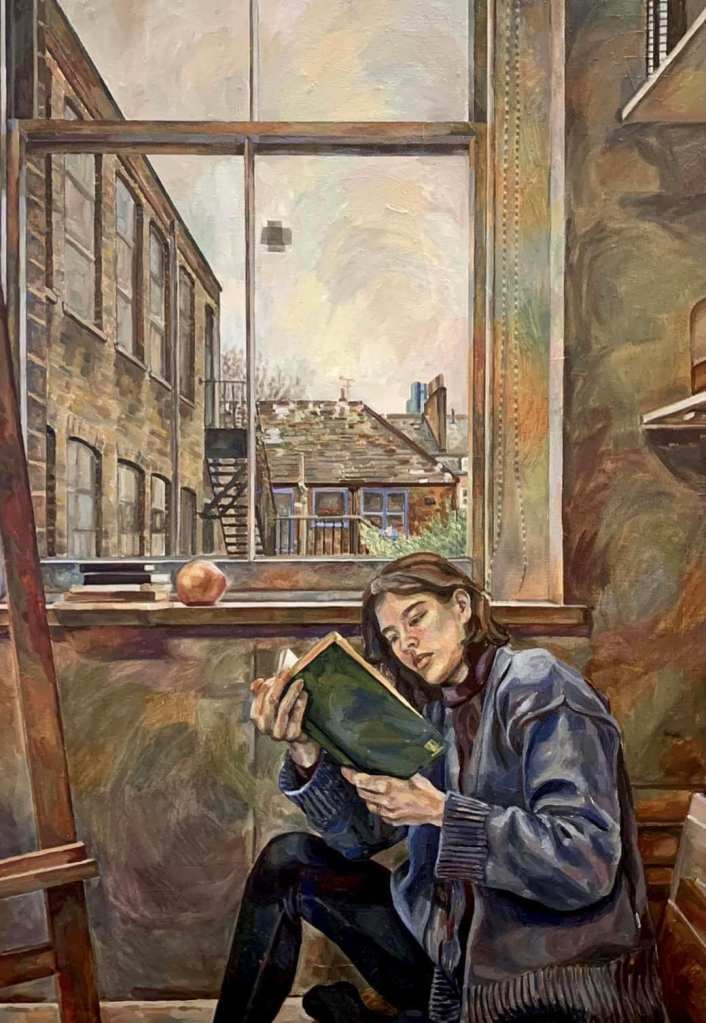
Kayoon Anderson, Studio Scene (2021); Mall Galleries, London, UK
Yes, I thought, that sounded right.
Those three key words really struck me — they resonated — and I repeated them aloud: “Life’s unheroic survivors.” Then nodded my head.
Yeah, I thought. That’s most of us, all right.
That was me, actually. The guy who’d just dropped eight bucks on a book he already owns five times over because he needed the comfort, the companionship, and the beauty of the story. Something to mark this day as a good one, a better one — distinct, and fresh, and hopeful.
I will live the day, really live it, not moping about lingering pain and a crappy sleep, is basically what I told myself.
Oh — when I was pushing Irving toward the Giant Tiger exit, I got a big idea and made a U-turn. Then strolled over to the candy section, and happily grabbed the biggest bag of Peanut M&Ms on the shelf — the kind you eat in one sitting when cramming for a mid-term at college.
I didn’t forget to pay for them, either.
Life’s unheroic survivors. Isn’t that really who we all are? I genuinely believe it is.
I have an addictive personality. I also love to read very good books. I like to collect them, too — various editions of favourite books, overlooked gems in the remainder bin, an armful of barely-read and well-loved cast-offs at a library book sale. If I go into a bookshop and leave without buying a book, I consider it a serious personal failure. I know it isn’t but it feels like it, and leaves me feeling muddled, if not a bit sad.
Years ago, a good friend came over to my apartment, a charming old second-floor one-bedroom walk-up on Quebec Street (which might sound like a nice street, but it was actually rather sketchy), with bathroom doors that could only be opened using a skeleton key, a peek-a-boo mail slot, and a rusty, wobbly fire escape off a kitchen window, which also occasionally served as a balcony. (Although I had to climb out the kitchen window to access it, and that was always precarious, especially if I had a beer in one hand.) At any rate, my place was filled floor-to-ceiling with CDs and books and movies, which that day prompted my friend, Brian, to say to me, “You know, you can only listen to one song at a time.”
I felt slightly hurt. How to defend myself? Eventually, I told him, “True, yeah. But I have lots to choose from. And I own them.”
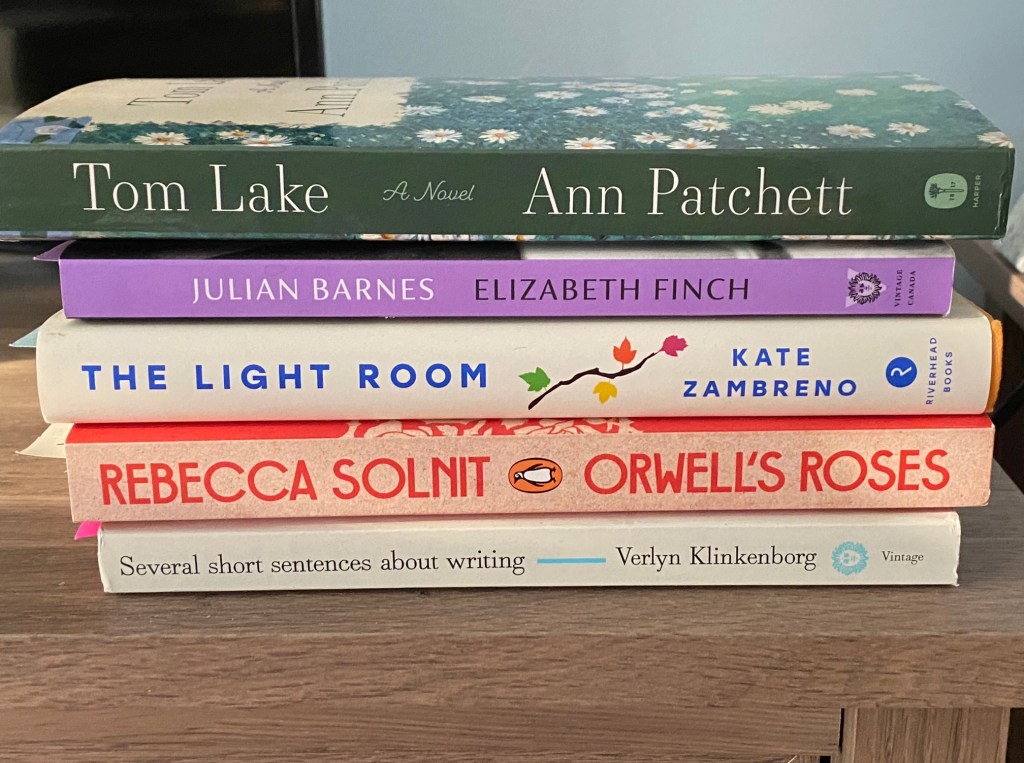
Other people’s books I am currently reading while revising my own. There are others.
“I just listen to the radio in my truck,” he said. “Bit of everything. And I can always flip the station.”
That sounded boring to me. Or more like the stuff of summer road trips. Anyway, he was missing the point, I thought.
“But this is like a library. My own library,” I said.
I think he shook his head. Maybe he mentioned money, and wasting it, like my dad often did. In any event, he wasn’t going to understand, so I gave up on the conversation and we talked about something else.
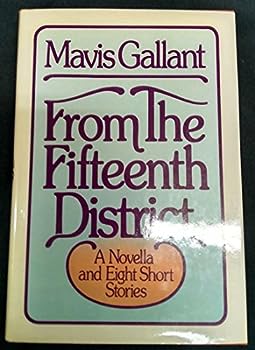
And just last winter, or perhaps the previous one, I was sitting in my parents’ garage reading a great book I’d just scored at a library used book sale: Mavis Gallant’s From The Fifteenth District. It was an older hardcover, in good shape, which I’d been thrilled to find a few days’s before. I’d been so happy with my haul; a tall stack of my other finds sat next to me atop Dad’s well-used, paint-speckled workbench.
“What are you gonna do with all those books?” my dad asked me.
I looked up. Sniffled a laugh. “Read ’em,” I said.
He made a face. “You don’t have enough books?”
“No,” I scoffed. “”Never!”
My next thought was kind of a sad one: I guess my dad will never understand me. Or that part of me, at any rate. He did recall I once opened my own bookshop, didn’t he? And that I’d had a novel published, and was hard at work on another?
Book lovers are often misunderstood. (So, too, are writers, but that’s likely another complicated story, best saved for another thread.) Book collectors are frequently misread as well.
My dear friend Steve — the late great (prodigiously brilliant and talented, really) writer and musician Steven Heighton — was over for a Music Night some years ago, and just back from the washroom, he said, “Johnny, you have this book in every room in your place.” He was holding an older trade paperback copy of Anne Morrow Lindbergh’s Gift From The Sea. Steve wasn’t teasing me or making fun of me, I don’t think. What he’d said merely sounded like an observation, one that seemed to amuse him.
“Yep, I do,” I said, doing the math in my head. There was a copy in the washroom, one on my nightstand, another in my main teak bookcase in the kitchen, and a fourth in the living room, on the TV stand. “I love it. It’s a favourite book. And whenever I see a used copy, I buy it. I like gifting it to people.”
Pretty sure he smiled at that, then sat back on his stool at my pub table, picked up his guitar, and we happily got back to the business of chatting and singing and laughing — well into the night.
I used to see people like me in my bookshop. The serious diggers. The first edition finders. The man who, one summer afternoon, paused before leaving the shop to say, “This is a wonderfully curated shop.” He didn’t buy anything, if I recall correctly, but he got it. He definitely got it. (And I am still, to this day, touched by his kindness.) A kindred spirit, that gentleman. There are others, I know. Many others. And I like these people.
This is all backstory, really, to what I’m feeling slightly uneasy about at the moment. The pickle is this: Can I read five books at once and write my novel — give it its due, and my all — at the same time?
But the answer comes easily: Yes, I can.
Some writers absolutely put blinders on when crafting a book. They won’t allow themselves to read other books. They’ll get away from home, retreat to a lakeside cottage, if possible — without a phone, or internet access, or another soul in sight. Anything that’s not in their notes or in front of them on the page is an unwanted nuisance. They require quiet. A clean sheet, a clear mind. And as few distractions as possible.
I get that. I’ve done similarly on writing retreats. Although I need my phone. And maybe two or three books for inspiration, a good notebook, and whatever books or magazines (though most often it’s books) I’m reading for research.
It might seem simple, but, to me, everything is research. Nora Ephron famously believed that “everything is copy.” Anything anyone around her said or did was up for grabs, and might just find its way into her work — it was fair game, all of it. I agree with that philosophy, although I dislike writing about the bad behaviour of people I know. Sometimes I don’t like writing about their good behaviour. Sharing those moments — as I have above, about my old friend, my dad, and Steve — is okay with me, I mean, of course it is, as long as it’s not done with malice or for showy reasons. We can share bits of our stories, and our memories, and that’s just fine with me because it’s very human (we are, indeed, a storytelling animal). If it does no harm, then, you know, work out. That’s my thinking, in essence.
I’ve wavered a bit, perhaps. My point is this: Reading a few pages at a time from one of the five books I’ve next to me on my coffee table is fine. It’s research. It’s inspiration. And when I take a break from writing, and sometimes simply want to unwind or try to blank out the screaming sirens on my busy street, I’ll allow myself to pick up Ann Patchett’s new novel, Tom Lake, and enjoy a few pages. I don’t need an excuse. It’s pleasurable. And yes, I very strongly believe reading is research.
Reading anything, really — a pamphlet at the pharmacy, a notice at the doctor’s office, a poster heavily stapled to a telephone pole. Observation is research. The mind is a sponge. Inspiration is everywhere.
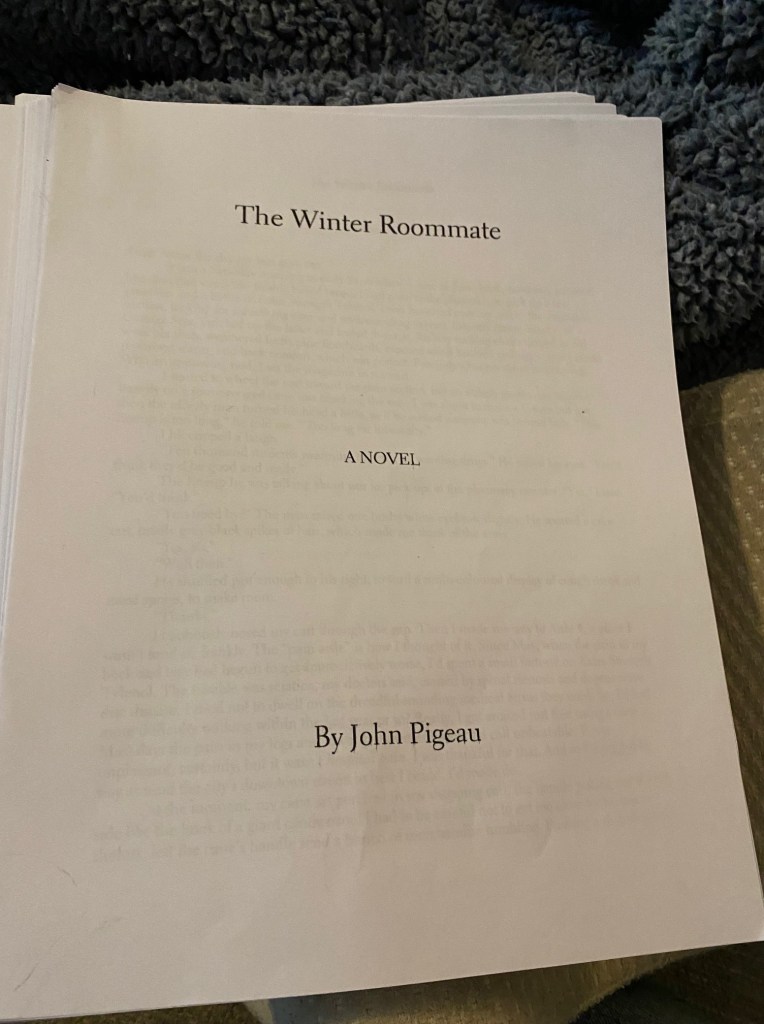
The manuscript of my novel is near me, too. I know where I’ve left my characters. I’m well aware they need tending to. That they have things to say and do. Yes, I sometimes feel guilty, like I’ve neglected them, if I can’t manage to write a new sentence or two in a day, or revise a few lines, or polish up some dialogue; if I haven’t, in any way, moved it forward. That uneasy feeling I get when I leave a bookshop empty-handed — that’s similar to how I feel when I haven’t touched my manuscript at all and it’s the end of the day, and my body and mind are tapped out.
My manuscript during revisions.
But, like all feelings, that uneasiness passes.
I mean, I’m not out vandalizing cars, right? I’m not at the pub drinking myself silly, either. And I’m not — I don’t know — playing Minecraft for hours on end.
Reading good books actually keeps me focused. I’m mindful of the way a writer styles their sentences. I’m learning that George Orwell was fairly obsessed with gardening. And that the key to good, clean writing, according to Verlyn Klinkenborg, might just be in making short sentences and knowing what each one says. (I’m also now aware that Verlyn, a name I’d never head before, might be an excellent name for a character, perhaps a revelatory genius!) And in reading Julian Barnes’ latest, Elizabeth Finch, I find myself exhilarated to realize, if I hadn’t already realized this, that there really is no “right way” to tell a story. His work is often unconventional. This novel certainly is, and I find his approach refreshing, enlightening, and entirely exciting (even though I found the middle of the book rather dull) — it’s like your favourite English professor whispering a brilliant tip into your ear, something that feels like a secret, clapping you on the back and saying, “And now you know. Off you go to write your masterpiece!”
“Weeks after the baby is born, summer turns to fall.”
That’s the first sentence of Jane Zambreno’s memoir, The Light Room. How crisp and compelling is that?!
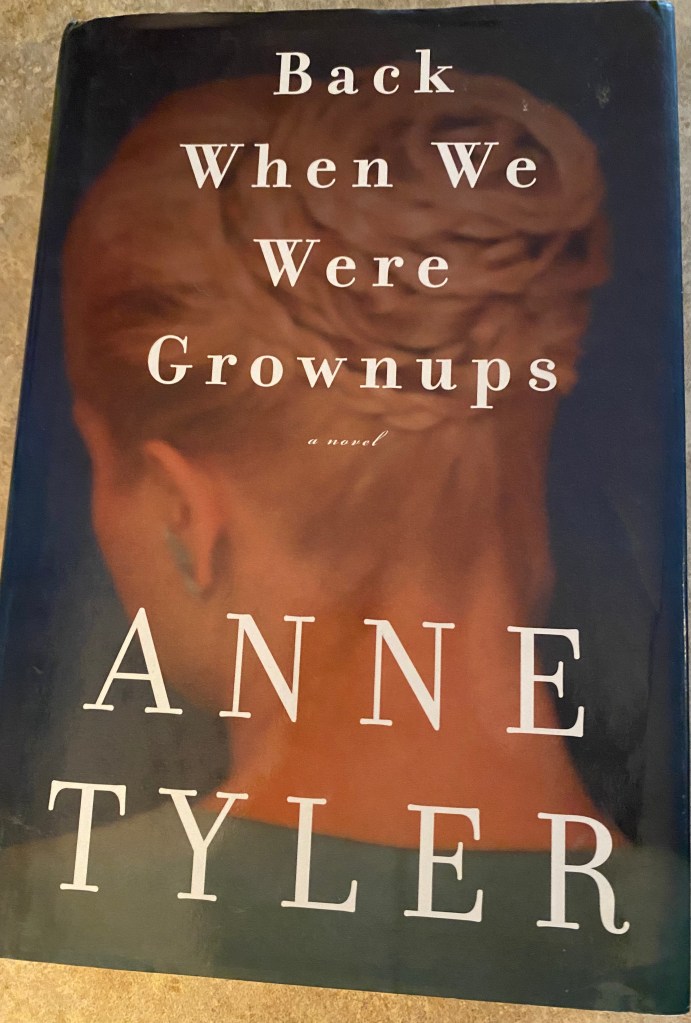
I love first sentences. Sometimes I’ll buy a book because the first sentence strikes me as brilliant. (In fairness, I’ve returned a few of those, or repurposed them, but not many.) Anne Tyler’s first sentences are warm, charming, graceful, funny, poised, sometimes strikingly bold but never snooty, and I’ve fallen in love with every one of them. Here’s the opening sentence from Back When We Were Grownups: “Once upon a time, there was a woman who discovered she had turned into the wrong person.” How audacious! How plucky! And she pulls it off beautifully, which is to say, Back When We Were Grownups is a superb, deeply moving work of fiction — and it just happens to have one helluva catchy first sentence.
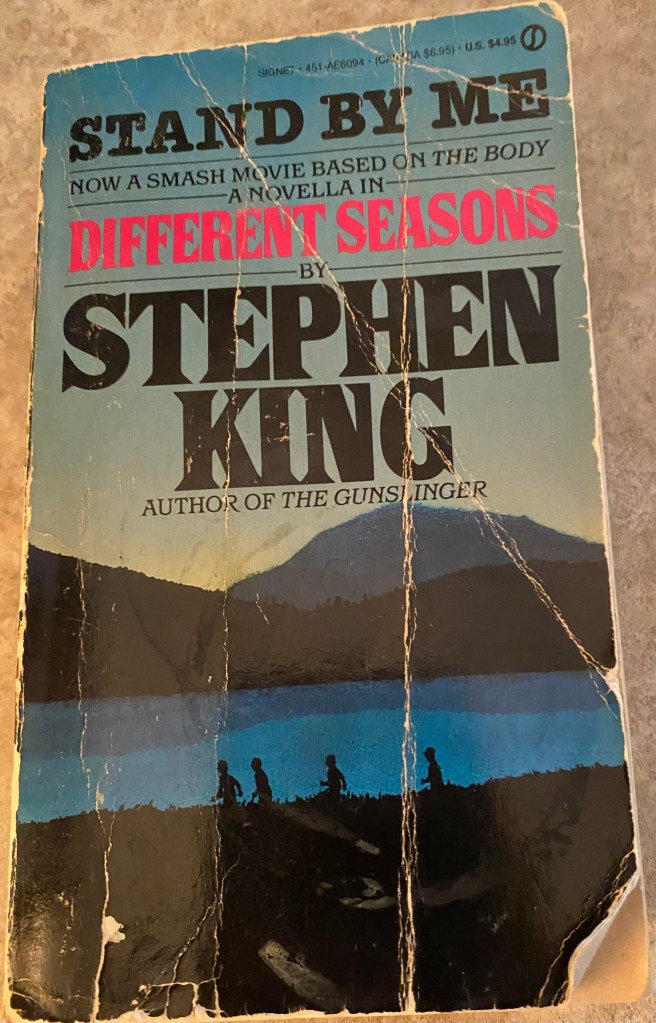
I still remember the first sentence of Stephen King’s novella “The Body,” which was later made into the film Stand By Me (the dialogue almost word-for-word from King’s story, the film’s narrative extremely faithful to the book); it’s this: “The most important things are the hardest things to say.” I first read that book when I was a teenager and worked as an usher at a movie theatre; Stand By Me was playing when I trained, and it played for months and months, and I must have seen it thirty or more times. My paperback copy of Different Seasons is gorgeously scruffy and dog-eared. I think I bought it at Cole’s Bookstore in the mall near the theatre. Anyway, I didn’t need to open the book again to remember that first line. I’ll never forget it.
My old copy of Different Seasons, an absolute beauty.
Reading is never a bad thing. Even when you’re hip-deep in heavily-inked-up manuscript pages, it’s still okay to learn. To allow yourself that gift. I believe it’s a vital part of the writing process. It’s like standing up to stretch after you’ve been at your desk awhile, stepping outside and walking barefoot in fresh-cut grass, feeling the sunshine warming your face, closing your eyes and listening to the leaves shiver in the breeze and the kids next door shouting, “You’re it! You’re it!” And if the air smells like cotton candy, you’d better write that down.
 One Good Thing