In his latest book, Andre Dubus III writes about physical pain, poverty, addiction, despair … and redemption
I’m a slow reader. Normally it takes me a couple of weeks to read a 300-page book. On the rare occasion when a book has me spellbound from the get-go, I’ll gobble it up in a week. Tops. I read Such Kindness by Andre Dubus III in four days.
That’s as close as I’ll get, these days, to reading a book in one sitting.
And to think: I’d come across the book by chance, really. One October afternoon, I was browsing the new fiction hardcovers at Novel Idea Bookstore and picked it off the shelf, for some reason. It wasn’t face out, so the cover art hadn’t hooked me. But this bit on the front-flap synopsis caught my attention: “A working-class white man takes a terrible fall,” I read — and then came the real kicker, “In constant pain, addicted to painkillers at the cost of his relationships with his wife and son, Tom slowly comes to realize that he can never work again.”
As unpleasant as it might be to read about a man in constant pain, something told me that I should, because I’m in constant pain, and maybe, just maybe, this man’s story might somehow help me — although I couldn’t have told you exactly how I’d hoped it might.
Although Ann Patchett’s back-flap blurb intrigued me, too. “Such Kindness,” she wrote, and I read, “charts a remarkable rebirth, not from poverty to wealth but from bitter helplessness to the knowledge of self-worth. The result is a gripping and transformational journey toward kindness, in a tremendously moving novel.”
Bitter helplessness. Transformational journey toward kindness. Tremendously moving.
In recent years, I have felt bitter and helpless. Mostly because of pain, and the trauma of loss. I’ve also come to value genuine kindness. In reading Patchett’s words, I felt a warm swell of hope.
That was just enough: I bought the book, and I’m mighty thankful I did.
* * * * * *
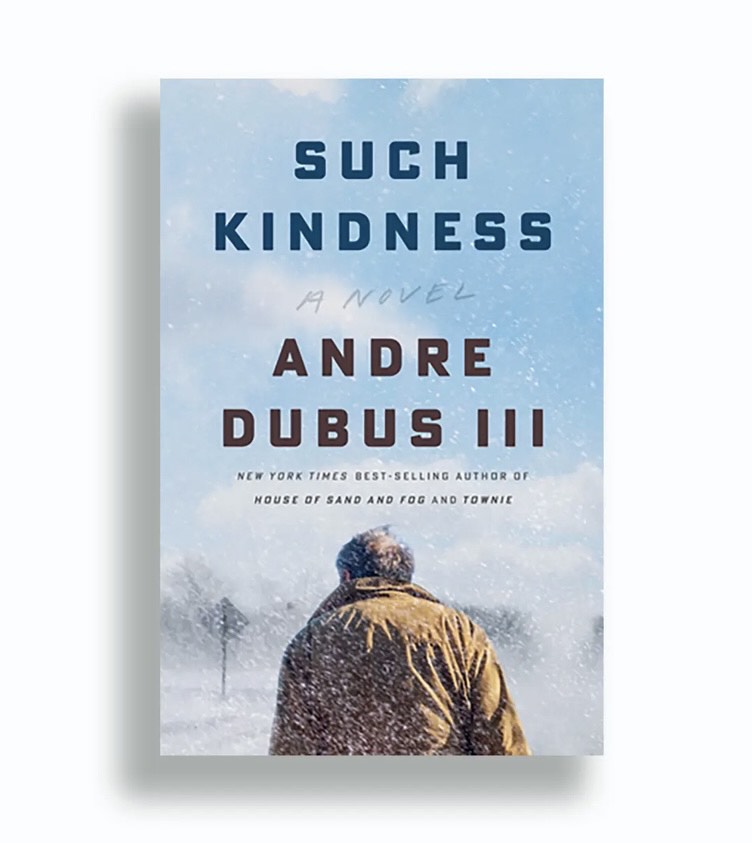
When we first meet Tom Lowe, who narrates Such Kindness, he’s lost just about everything. Everything that matters to him, anyway: a wife he dearly loved, a son he was devoted to, and the beautiful dream home he built for them — with a wall of windows and an open view of a saltwater marsh, where the “air smelled like pine needles and the ocean.” He’s lost his career as a carpenter, too. This happened in an instant. His mortgage had nearly doubled, and he was working wearingly long hours to keep up — until one day, while shingling a roof, in a moment of fatigued inattention, too much sunlight in his eyes, Tom fell three storeys and was irreparably, severely injured. Surgeries followed. Yet, now — years later — Tom’s still in constant pain, living in subsidized housing, and addicted to cheap vodka, or, as he calls it, his “liquid pain distracter.”
In the book’s opening pages, he recounts: “I have spent many hours contemplating pain. Its constant presence seems like a dark joke, really. Like the bully at school who sits on your chest and spits on your face years after both of you have moved on. My pelvis and hips were fractured years ago. Do they have to keep spitting in my face?”
If you’ve had an injury and suffer chronic pain, you’ll know just how spot-on this analogy is. Pain is a relentless bully. And if Tom comes across here as bitter, it is an arguably justifiable feeling. After I read those words, I felt deeply for Tom.
He is, after all, a good man. And we glean this early on, even though when we first meet him he’s stealing his banker’s trash hoping to find a “convenience check” from a credit card company. He’s desperate, yes, and living in Section 8 housing, but Tom was a once successful carpenter who loved to build things. He took great pride in a job well done, but is now unable to work. After his accident, he got addicted to opioids, at the cost of his relationships with his wife and son. But he’s kicked that habit now. And what he wants most is to see his son, Drew, who is about to celebrate his 20th birthday.
Trouble is, Drew lives on campus in Amherst, a hundred miles west and Tom’s car has been impounded. Why? Because he drove his neighbor, Trina, to a lab so she could sell her plasma to make rent, and he was ticketed by a young police officer for driving an unregistered, uninsured vehicle and (because he left his empty wallet at home) for driving without a license. The fines add up to $1,637, and Tom has no way of paying them. His income is meager. He receives monthly disability checks and E.B.T. cards, which he sells for cash to buy toilet paper and the cheap vodka that helps quell the red-hot pain caused by the screws in his hips. Most of his groceries come from a local food bank.
Deftly, Dubus avoids making Tom out about to be a “sad case.” Instead, he depicts Tom as a man who loves his son and wants only to visit him on his birthday — seemingly, at this point, Tom’s only glimmer of hope. Much of the time, it’s true, he is in terrible pain. He lies on a slat of plywood over the cushions of his couch and drifts into pain- and alcohol-induced dreams and remembrances of days gone by (both good and bad). And he doesn’t feel like he belongs in subsidized housing. His neighbours are loud, foul-mouthed, sometimes violent characters. In contrast, in his many recollections of a time before his devastating accident, we see Tom living in a warm and comfortable home, a hard-working tradesman, a proud, caring father, and a husband fortunate to have a smart and beautiful wife, who once loved him very dearly. It’s easy to understand Tom’s dizzying sense of dislocation.
Shortly after he’s hatched a plan to commit credit card fraud, Tom has a change of heart. He just can’t do it. It’s wrong, it’s dishonest. Not so long ago, after all, Tom was a man who believed in earning honest money through hard work. He’s bitter toward the banker who trapped him in a disastrous subprime loan that cost him his home, yes, but, in the end, Tom can’t steal from the man. Was I really going to be a thief? he asks himself.
No, he wasn’t. “Which is why I need to sell the only valuable things I have left — all the tools left in the basement of my unit,” he thinks. “They took me years and years to collect, buying one or two at a time but only when I needed them … The truth is, I should have sold them all years ago. But if I had, it would be like selling the last of my once-toned muscles, my genitals, my very bones — broken or not — my brain and hands that, together, still knew how to do so much constructive good.”
This decision feels vital. A change in mindset. Possibly a first step toward transformation. Those tools were instruments of a noble profession, after all, and now Tom’s willing to part with them. All to spend time with his estranged son. We sense a sort of letting go.
An unsavoury neighbour takes photos of the tools for Tom, and Tom posts them for sale on Craigslist. When he quickly finds a buyer, he’s filled with gratitude. “Three thousand two hundred dollars,” he thinks. “I’ll be able to get my car back and still have twelve hundred left over. I picture myself taking Drew and his closest friends out to the nicest place in Amherst. A steakhouse, maybe, some low-lit establishment that serves juicy prime rib on thick platters. I picture myself being able to rent a room for the night in some B&B under pine trees, me and my son sitting on the porch drinking coffee or tea. Drew’s turning twenty and it’s time that I told him a few things about this life, something that might truly help him.”
Tom’s jubilant. And it’s impossible not to feel good for him. But before the buyer’s arrive at Tom’s apartment, he is shocked to find his tools have been stolen. Dubus is a skilled novelist; he telegraphs nothing, so this loss comes as a shock to the reader, too.

Tom is gutted. He’s pissed off, too. But he doesn’t own a phone. Barefoot, wearing a T-shirt and khakis, he walks into Dawn’s Hair & Nails, tells the owner he’s been robbed, and she lets him use their phone to call the police. The police can’t do much over the phone, they tell him; he needs to file a report, in person.
He marches home, puts on some half-decent looking clothes so that the cops don’t think he looks poor and disabled. He pulls on socks and work boots, and puts on a wrinkled button-down shirt and a never-worn sweater, possibly a long ago gift, “tiny decorated Christmas trees across its chest.” He shaves and combs his thinning hair, to “look more like a citizen.” The pain in his hips is raging; he feels like a “broken-boned dog.” And can they really not send a fucking cruiser over? he asks himself. Angrily, he trudges on foot to the police station, a mile across town, maybe two.
This short scene is superbly written. Every character we encounter is real and recognizable, although, as in life, not always predictable. Dubus portrays each convincingly, with pitch-perfect dialogue and eloquent, easy-flowing prose. He possesses the rare and remarkable ability to understand people from all walks of life — the poor, the middle class, rich bankers, thieving drug addicts, goodhearted shopkeepers, workaday cops.
At the police station, Tom is agitated, breathless, sweating, his hips engulfed in pain. A young policewoman takes down his information and, after he requests it, kindly brings Tom a Styrofoam cup of water. He’s grimacing, and the officer asks him if he’s all right. “No, I’m not,” he tells her. “I need to lie down a minute. Is there a place I can lie down?”
The station officer lets him lie down on a steel bench in a holding cell. A bit later, she offers to drive him home. Home, Tom struggles to get out of the cruiser, and the officer offers to help him getting to his unit. She rests one hand on his lower back. To Tom, it’s a lovely feeling. The officer is sincere and kind, and Tom is moved.
When was the last time he felt such affection? I wondered. When you’re poor, disabled, and alone, lack of human touch can be common, unpleasant, emotionally wearing. Many of us know this firsthand.
Not long after this, Tom learns that Larry, the friendly, happy-go-lucky gentleman who owns Larry’s Liquors has died. The affable shopkeeper had always been nice to Tom, and Tom genuinely cared for the man. At the funeral home, Tom feels wrapped in a strange sense of peace. He also feels a certain clarity about two things: one, he’ll probably never get his car back, because, two, he’s not willing to be the kind of man who knowingly hurts others to help himself. It would be a foolish way to live, he thinks, “grasping at dollars and coins when one day our hearts will stop as finally as Larry’s has.”
Tom has softened. He says some very kind words to Larry’s widow, and she thanks him, remembering his name; he feels buoyed by this, perhaps he’s actually helped her in some way. To Larry’s daughter, Tom says, “Your dad will always watch over you.” He rests a hand on her shoulder. She wraps her arms around him and cries into his Christmas sweater. Tearfully, she thanks him. Leaving the funeral parlour, he feels an uplifting sense of virtue. He asks a stranger if he can borrow his cell phone to call a taxi. Just like that, the man says, “You bet.” And Tom thinks to himself: “It’s hard not to feel that I’m in the heart of some kind of higher lesson I should’ve learned a long time ago.”
This scene is about halfway through the book. And there’s a noticeable shift in tone. Tom no longer feels like a helpless victim. He’s come to accept some painful truths. And he’s kinder to people, more open and honest, with a genuine generosity of spirit. And then, one by one, good things begin to happen for him. Small things, perhaps — compassionate gestures, a sincere and thoughtful word or two — but one’s Tom is mindful are really quite profound and beautiful. His kindness is met with kindness. People react differently to him, and he likes it. More importantly, he appreciates it. And his bitter feelings begin to fall away.
In one particularly poignant scene, Tom returns to the hair salon and asks the street-savvy owner if he can use her phone again. It’s his son’s birthday, he explains, he needs to call him but has no way to contact him. Dawn, the shopkeeper, is slightly wary of Tom at first but quickly recognizes he’s a good person in a rough spot. She kindly lets him use her cell phone, dialing for him, even phoning 411 to get several numbers that Tom doesn’t know. He’s in severe pain, too, so she lets him lie on the floor of the salon to rest. While he talks to his ex-wife and then one of his son’s roommates on the phone, Dawn makes him a coffee.
Such kindness, Tom thinks.
“Were you a good dad?” Dawn asks him, a bit later.
“I was before I got hurt,” he tells her.
Before the accident, that is; with a smile, Tom adds, “And the foreclosure and the divorce and … the painkillers. I got hooked on those.”
Before he leaves, Dawn calls him “hon.” And he’s touched. Tom describes the feeling: The word hangs in my head like a votive candle, its flame burning steadily.
This happens every day: a person feels so disconnected from other decent people in the world, that one act of affection, one tender word, can serve as a powerful reminder that they belong. It’s one small moment of kindness. But it matters, it’s meaningful.
These “small,” accumulative moments of kindness continue throughout the novel. Though they surprise and delight, there’s nothing at all mawkish about them. We recognize them as things that happen in life. And who ever can say why? Are people innately good? No, not all. Does kindness always breed kindness? Not always, of course not. In Such Kindness, these moments are allowed to be. And they fill Tom with more of that uplifting sense of virtue he felt at the funeral home.
Such Kindness is a magnificent, powerful, and profoundly human novel. It’s beautifully written and skillfully structured. Dubus understands people who have endured tremendous pain and loss, and he’s able to portray life’s cruelties, and his characters’ reactions to them, compassionately, with a deft and delicate touch.
Reading the final third of this book, I was nearly shaking — with anticipation, fear, and, most of all, hope. I identified with Tom’s physical pain. I was in a great deal of pain, in fact, much of the time I read the book. And I know what it’s like to lose the person you love most in the world, too — the agonizing sorrow of being left, the helpless feeling of being abandoned. I genuinely cared for Tom. He felt real to me, a kindred spirit, and I wanted him to find contentment. Happiness. A sense that he was valued and loved.
I won’t spoil the end of the novel for you, but I will say that Tom eventually finds his way to his son. It’s one hell or an ordeal, his hobbled, humbling journey from a tiny apartment in Amesbury, Massachusetts to where his son goes to school in Amherst. And what he endures along the way would likely break some people. It’s truly astonishing that Tom doesn’t break — go mad, violently take matters into his own hands, or just give up. But he doesn’t. Instead, he is, again and again, surprised and overwhelmed by other people’s goodwill and generosity. He is truly grateful for these blessings, too. And by the end of the book, he is a freer, better soul.
Ultimately, Such Kindness is a story of acceptance. And holy hell, is it hard-won! Tom Lowe is a beautifully written character, one I’ll remember for a long, long time. For me, Such Kindness was a soul-stirring, life-changing novel. I suspect it will be for many. There are books that make us better people, and Such Kindness is among them.
* * * * * *
 One Good Thing
Leave a comment